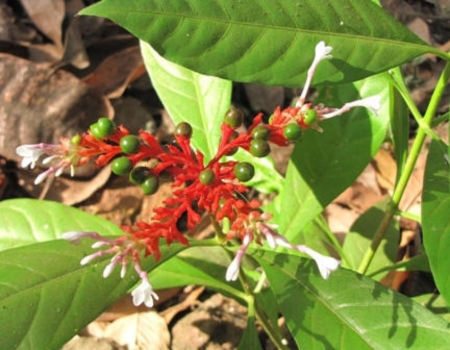
Organic Sarpgandha Plant Cultivation
Sarpagandha (Rauvolfia serpentina) is used in Ayurveda, Unani and folk medicines as well as in conventional western medicine. This plant is also known as Indian Snakeroot; in Sanskrit as Sarpagandha, Chandrika, Sarpakshi , Patalguruda; in Hindi as Chandrabhaga, Chota-chand, Sarpagandha; in Assamese as Arachoritita; in Bangla as Chandra; in Kannada as Sarpangandha, Sarpagandhi, Shivanabhiballi, Sutranavi, Patalagandhi; in Malayalam as Churannavilpori, Suvapavalporiyam; in Marathi as Harkaya: Harki; in Tamil as Chevanamalpodi; and in Telugu as Patalaguni, Patalagaruda, Sarpagandha.. The plant contains a number of bioactive chemicals, including ajmaline , deserpidine , rescinnamine , serpentinine , and yohimbine . The alkaloids in the plant reduce blood pressure, depress activity of central nervous system and act as hypnotics. The useful parts are roots and leaves. According to Ayurveda the root is bitter, acrid, sharp, and pungent and anthelminic. Rauvolfia preparations are used as antihypertensive and as sedative. It is also used in the treatment of various central nervous system disorders associated with psychosis, schizophrenia, insanity, insomnia, and epilepsy.
Send EnquiryMarket Potential:
The natural reserves of this plant are declining as a result of over-harvesting especially after reports of its medicinal properties appeared in the literature. International Union for the Conservation of Nature and Natural Resources (IUCN) has kept this plant under endangered status. Importers, buyers within the country, processors, traditional practitioners, Ayurvedic and Siddha drug manufacturers throng the markets for procurement of this plant every year. Its domestic demand is quite large. As the production is much less in India, the internal market itself is highly potential.
Basis And Presumption:
1. The agricultural land and related infrastructure is available with the entrepreneur.
2. Prices are calculated as per the prevailing market rates.
3. The yields depend on proper implementation of package of practices.
4. Economics of cultivation greatly improves on scale of operation.
5. This activity provides tax-free high returns. Additionally a number of government support schemes are available. (Ssp group) Latest provisions need to be checked up.
Market for medicinal plants is volatile and economics may vary from time to time.
Agro Practices:
Sarpagandha is an erect perennial shrub with a long, irregularly, nodular, yellowish root stock. The leaves are long, lanceolate and bright green in color. They are borne on stem in whorl of three. The flowers are pink or white and are found in clusters. The fruits are small, globose; initially greenish purple in color but eventually turning blackish when ripe. Flowering time is March to May in Indian conditions.
Soil And Climate:
The plant prefers soil with plenty of humus and rich in nitrogenous and organic matter with good drainage. Alkaline soils are not suitable for commercial cultivation. The sandy loam to medium black cotton soils rich in organic matter with pH 6-8 and good drainage facility are suitable. It grows in a wide range of climatic conditions but flourishes well under hot humid tropical climates in open or partial shade. Elevations of 1300 m having a temperature range of 10-38°C and annual rainfall of 2500 mm are suitable to this species. Good yield is obtained in areas less prone to frost and having less severe winter.
Propagation:
About 5-7 kg seeds are required for sowing one hectare area. Fresh seeds are preferred for sowing as their viability lasts for only 6 months. It has been observed that the seeds stored for more than a year are difficult to germinate. Therefore it is essential that seeds collected between September to December should be used for planting in the following season. Seeds are treated with Thiram (2-3 g / kg seed) after soaking in water for 24 hours and sown from the end of April to the first week of May at a distance of 8-10 cm and 1-2 cm deep. These are covered with a mixture of FYM and soil and irrigated daily. Germination is complete in 30-35 days. The germination rate varies from 10-50 per cent. Agro Practices: Soil And Climate: Propagation: It can also be propagated by vegetative means using stem and root cuttings and root stumps. Root cuttings 30-50 mm long and not exceeding 125 mm diameter are planted in June- July and are covered completely with the soil leaving only 10 mm above the surface. The cuttings sprout within 3 weeks if there is good moisture. Success rate is 50-80 % and around 100 kg of root cuttings are required to plant one hectare area. Stem-cuttings 150-200 mm long with 3-4 nodes are planted in the nursery in June and kept moist until they sprout. Cuttings treated with IAA (30 ppm) initiate rooting in 15 days. The success rate obtained in stem cuttings is about 65%. In case of root stumps, approximately 50 mm roots with a portion of stem above the collar are planted in May- June in irrigated fields. Though around 90-95 % of success is obtained in this method, only one plant can be raised from a single stump. Seedlings, 40 - 50 day old bearing 4-6 leaves, are ready for transplantation in the first week of July. These seedlings are uprooted and treated with Bavistin 0.1% for 30 minutes and then transplanted at a distance of 450 x 300 mm in the main field. This is followed by a light irrigation. Around 10-15 % of the seedlings are retained for gap filling 10-15 days after planting.
Fertilizer:
Generally organic cultivation is practiced. Before sowing 10–15 tones of farm yard manure/ha is used. In the nursery, FYM (1/3rd of recommended dose) along with 2/3rd of soil mixed with 10 % B.H.C @ 20 kg per hectare is required. 30 kg Nitrogen and 30 kg each of Phosphorus and Potash per hectare are required. At the time of planting, 1/3rd of Nitrogen and the entire dose of Phosphorus and Potash are applied 450 mm away from the rows and 70-100 mm deep. 50 days after planting 2/3 rd Nitrogen is applied and the remaining Nitrogen is top dressed in the next rainy season.
Harvesting, Yield & Returns:
Nearly 15-16 irrigations are required. Irrigation is required twice a month during hot dry season and once a month in the winters. Sarpagandha being a long duration crop and slow in growth in the initial stages can be intercropped. Vegetables like brinjal, cabbage, okra and soybean may be planted in Kharif.


