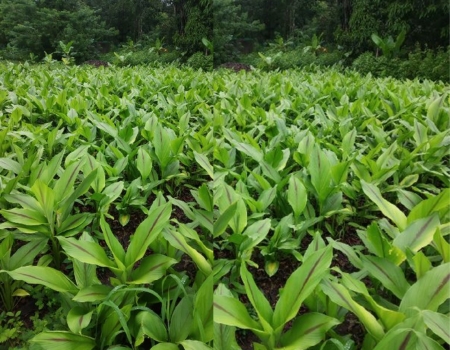
Organic Black turmeric Plant Cultivation
Turmeric (Cucurma longa) known as ‘Haldi’ in Hindi belonging to family Zingiberaceae is a popular and sacred spice from India. It is used as an important condiment and as a dye with varied applications in drug and cosmetic industries. A by-product of turmeric called ‘ Kumkum’ or the sacred vermilion has importance in many Hindu religious ceremonies, offerings and festivals. In India, Andhra Pradesh is the leading state followed by Maharashtra, Tamil Nadu, Orissa, Kerala and Bihar. Turmeric plant grows from the rhizome and the leaves are broad, long and bright green in color. The plant does not have a well-defined stem. The flowers are pale yellow and are borne on spikes. Cultivation: Turmeric is a tropical herb and is grown in both tropics and subtropics. It needs a warm, humid climate for growth. Clayey soil with a large amount of humus is best for growing turmeric; however, it can also grow in sandy soil that is well-drained. Turmeric seed rhizomes from previous harvest are used for cultivation of turmeric in next crop rotation cycle. The planting time varies from state to state, for example, it is around April in Kerala, May in parts of Maharashtra &Karnataka. Approximately, 400kg rhizomes are needed for planting in one acre of land but if it is being used as an intercrop then the seed rate can be 125kg/acre. Depending on the variety, turmeric is ready for harvest within 9-11 months of sowing. They are ready for harvest when the leaves and the stem start turning brown and dry up progressively. Generally, pure turmeric yields a quantity of 10000 kg /acre.
Send Enquiry

